

Starting your investment journey can feel overwhelming, but understanding the Indian stock market is the first step toward building long-term wealth. This guide is designed to simplify the process, making it easier for beginners in India to get started. Whether you’re a young investor looking to grow your savings or someone aiming to secure your financial future, understanding the stock market is essential for making informed investment decisions.
📘 What Is the Indian Stock Market?
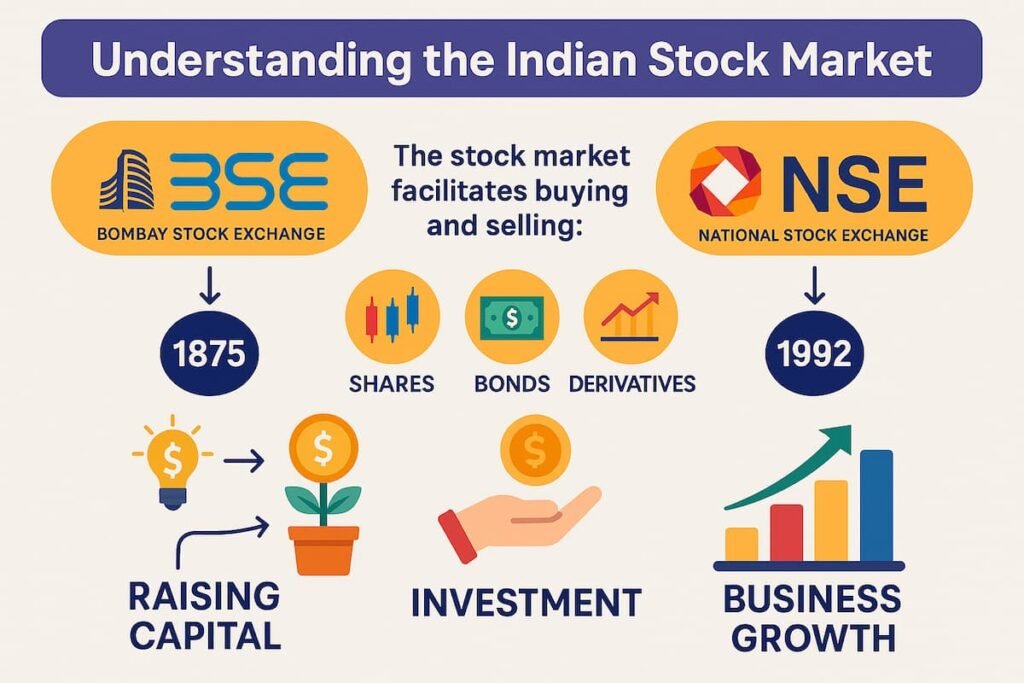
The Indian stock market is a platform where individuals and institutions buy and sell shares of publicly listed companies. It plays a critical role in the country’s economy, allowing companies to raise capital and offering investors the chance to benefit from the growth of businesses. There are two primary stock exchanges in India:
- Bombay Stock Exchange (BSE): Founded in 1875, BSE is Asia’s oldest stock exchange.
- National Stock Exchange (NSE): Established in 1992, NSE is the largest in India by trading volume.
These exchanges facilitate the trading of various financial instruments, such as stocks, bonds, and derivatives. The market is regulated by the Securities and Exchange Board of India (SEBI), which ensures fair practices and investor protection.
🧭 How Does the Indian Stock Market Work?
The stock market operates on the basic principle of supply and demand. Investors buy shares of companies they believe will perform well, and sell shares of companies they expect to underperform. The price of a stock fluctuates based on various factors, such as market sentiment, company performance, and economic conditions.
Key Components of the Indian Stock Market
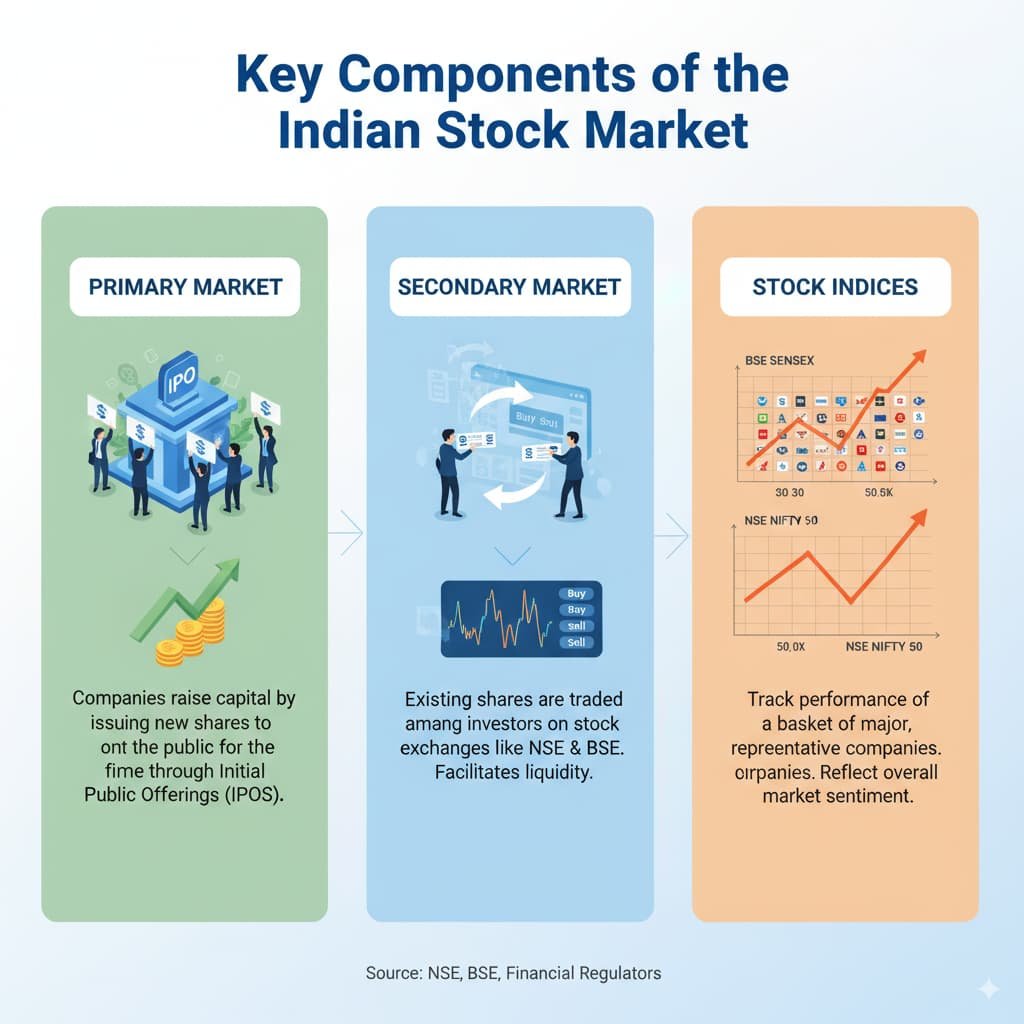
- Primary Market: This is where companies raise capital by issuing new shares to the public through Initial Public Offerings (IPOs).
- Secondary Market: Once shares are issued in the primary market, they are traded among investors in the secondary market.
- Stock Indices: Indices such as the BSE Sensex and NSE Nifty 50 serve as benchmarks, tracking the price movements of a selected group of major companies. These indices give investors an overall view of the market’s performance.
🧰 How to Start Investing in the Indian Stock Market
1. Open a Demat and Trading Account
To begin investing in the stock market, you will need two essential accounts:
- Demat Account: This account holds your shares in electronic form.
- Trading Account: This is used to buy and sell shares.
These accounts can be opened with SEBI-registered brokers, and the process typically requires basic documents such as PAN, Aadhaar, and a bank account.
2. Choose Your Investment Strategy
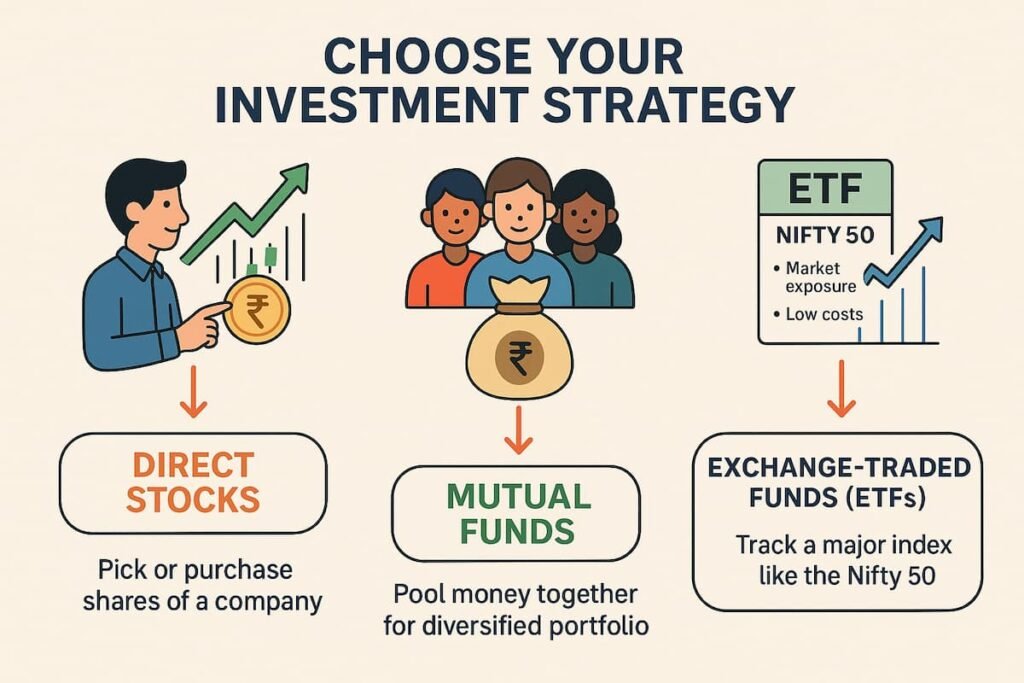
You can invest in the stock market through various options:
- Direct Stocks: Buy shares of individual companies.
- Mutual Funds: Pool your money with other investors to invest in a diversified portfolio.
- Exchange-Traded Funds (ETFs): These funds track major indices like Nifty 50 and offer broad market exposure at low costs.
3. Research and Select Stocks
Before investing, it’s important to research the companies you’re interested in. Look at their financials, growth potential, and market conditions. Use resources like company reports and financial news to make informed decisions.
4. Start Small and Diversify
Begin with small investments and diversify your portfolio. This reduces the risk of your entire investment being impacted by the poor performance of one stock. Regular investments through Systematic Investment Plans (SIPs) can also help you benefit from the power of compounding.
📊 Understanding Market Indices
Stock market indices like Sensex and Nifty 50 represent a group of large, publicly traded companies. They act as indicators of the market’s overall health and performance.
- Sensex: Tracks the performance of 30 major companies listed on the BSE.
- Nifty 50: Represents 50 top companies listed on the NSE.
These indices are widely used by investors to track market trends and compare the performance of individual stocks.
⚠️ Common Mistakes to Avoid
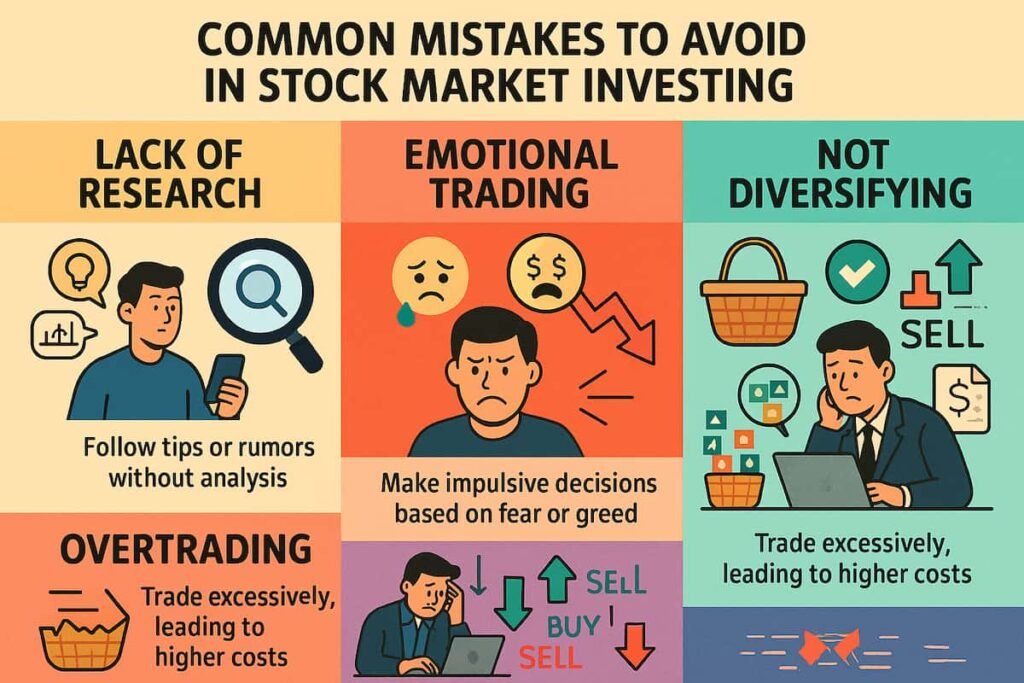
Avoiding common pitfalls is key to successful investing. Here are a few mistakes to steer clear of:
- Lack of Research: Always do thorough research before buying any stock. Avoid making investment decisions based solely on tips or rumors.
- Emotional Trading: Investing driven by emotions, such as fear or greed, can lead to poor decisions. Stick to a well-thought-out plan and avoid impulsive actions.
- Not Diversifying: Diversifying your investments across different stocks and sectors helps reduce risk. Avoid putting all your money into a single stock or industry.
- Overtrading: Frequent buying and selling can increase transaction costs and reduce overall returns. A long-term investment strategy typically provides better results.
🧾 Taxation on Stock Market Investments
When you invest in the stock market, it’s essential to understand the tax implications:
- Securities Transaction Tax (STT): This tax is levied on the purchase and sale of securities. It is paid during the transaction.
- Capital Gains Tax:
- Short-Term Capital Gains (STCG): If you sell stocks within 1 year (for equity) or 3 years (for debt), gains are taxed at 15% (equity) or 10% (debt).
- Long-Term Capital Gains (LTCG): If you hold stocks for more than 1 year (equity) or 3 years (debt), gains are taxed at 10% (equity) or 20% (debt) with indexation benefits.
It’s important to factor these taxes into your investment decisions to ensure you keep as much of your returns as possible.
❓ Frequently Asked Questions (FAQ)
Q1: What is the Indian stock market?
A: The Indian stock market is a platform for buying and selling shares of publicly listed companies in India. The two primary exchanges are BSE and NSE.
Q2: How can I start investing in the stock market?
A: To start investing, you need to open a Demat Account and a Trading Account with a SEBI-registered broker. These accounts allow you to hold and trade stocks electronically.
Q3: What are the risks of investing in the stock market?
A: Investing in the stock market carries risks such as market volatility, economic downturns, and individual company performance. It’s important to conduct thorough research and diversify your portfolio.
Q4: What is the best time to invest in the Indian stock market?
A: The best time to invest is when you have a long-term horizon and are prepared for market fluctuations. Investing regularly through SIPs helps you mitigate short-term volatility.
Q5: What is an IPO (Initial Public Offering)?
A: An IPO is when a company offers its shares to the public for the first time to raise capital. Investors can purchase these shares before they are listed on the stock exchange.
Q6: What is the difference between BSE and NSE?
A: BSE is the oldest stock exchange in India, founded in 1875, while NSE was established in 1992 and is the largest by trading volume. Both exchanges serve similar functions but operate independently.
Q7: How do stock prices change in the market?
A: Stock prices fluctuate based on supply and demand, influenced by factors like a company’s performance, overall market sentiment, and economic conditions.
Q8: What are stock indices like the Sensex and Nifty?
A: Sensex and Nifty are stock market indices that track the performance of a group of major companies. Sensex represents 30 companies, while Nifty includes 50.
Q9: How are stock market gains taxed in India?
A: Short-term capital gains (STCG) are taxed at 15% for equity investments held for less than a year, while long-term capital gains (LTCG) exceeding ₹1 lakh are taxed at 10% for equity.
Q10: What is the importance of diversification in stock market investing?
A: Diversification reduces risk by spreading your investments across various stocks and sectors. It helps ensure that the poor performance of one investment doesn’t drastically affect your overall portfolio.
🔚 Conclusion
The Indian stock market offers significant opportunities for wealth creation, but it’s important to approach it with a clear understanding and a disciplined investment strategy. Starting with basic research, maintaining a long-term outlook, and diversifying your investments will set you up for success. Remember, investing is not about timing the market perfectly but about staying consistent and patient.