
India’s stock market is one of the largest in the world, and it operates through two major stock exchanges—the National Stock Exchange (NSE) and the Bombay Stock Exchange (BSE). These exchanges are integral to India’s financial market, providing a platform for investors to trade various financial instruments. While both exchanges play similar roles, there are several differences between them that impact the way they function and how investors participate.
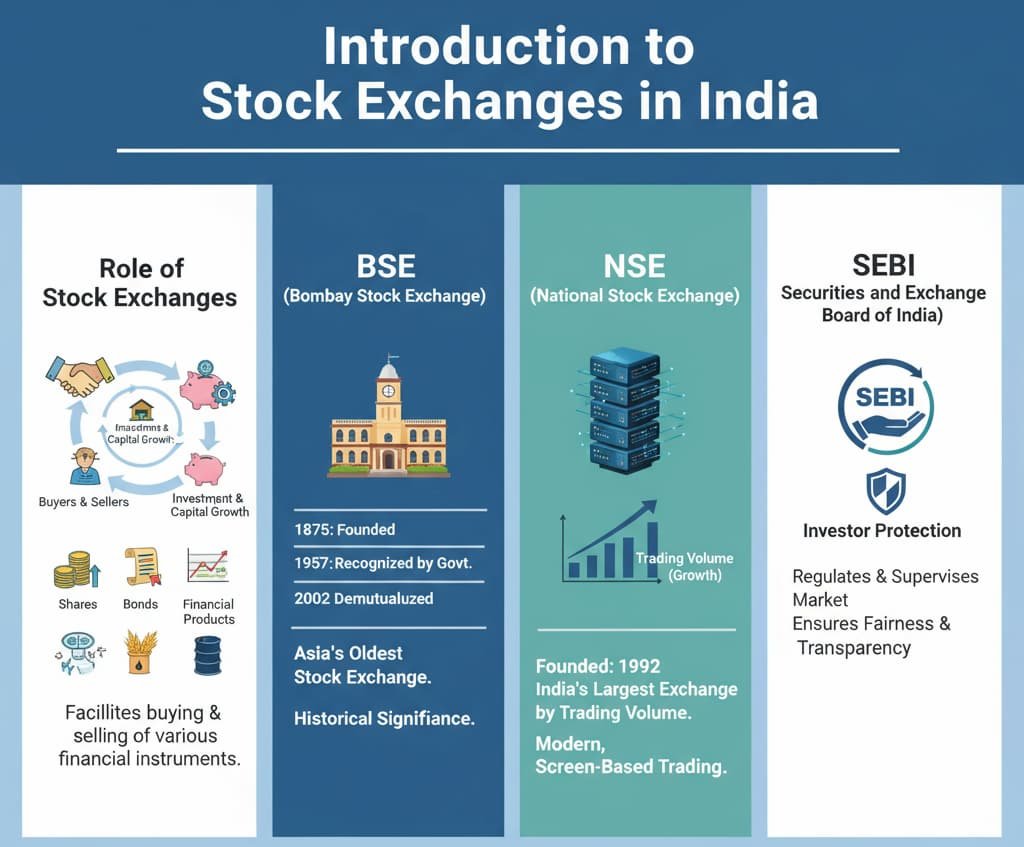
📘 Introduction to Stock Exchanges in India
The stock exchanges in India provide a platform where investors can buy and sell shares, bonds, commodities, and other financial products. The two main exchanges—BSE and NSE—serve as the backbone of the Indian financial market. Both are regulated by the Securities and Exchange Board of India (SEBI), which ensures a fair and transparent trading environment. However, there are key differences in their history, operations, and significance.
🏛️ Bombay Stock Exchange (BSE)
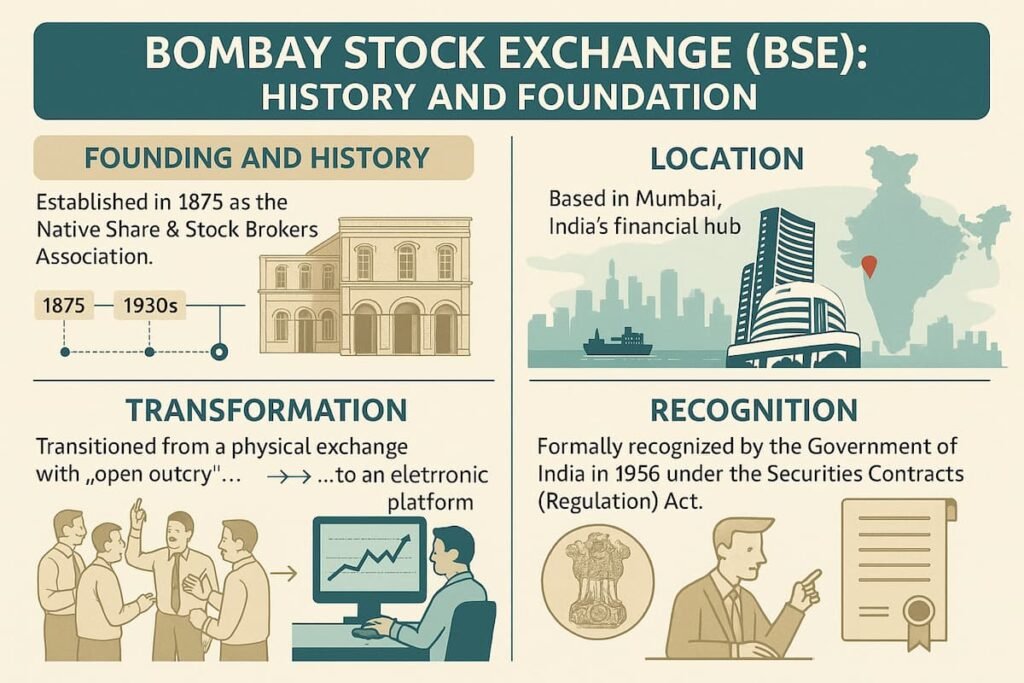
History and Foundation
- Founded: The BSE is the oldest stock exchange in India, founded in 1875 as the Native Share & Stock Brokers Association. It was granted formal recognition by the Government of India in 1956 under the Securities Contracts (Regulation) Act.
- Location: Located in Mumbai, the BSE was initially a physical exchange where trading occurred through a traditional “open outcry” method. Over time, it has transformed into an electronic exchange.
Key Features
- Sensex: BSE is home to the S&P BSE Sensex, one of the oldest and most widely followed indices in India. It tracks the performance of 30 major companies listed on the exchange, representing a significant portion of India’s economy.
- Listing: BSE has over 5,000 companies listed, making it one of the largest exchanges globally in terms of the number of listings.
- Market Capitalization: As of recent years, BSE has a market capitalization of over $2 trillion, making it one of the largest exchanges in the world.
🧭 National Stock Exchange (NSE)
History and Foundation
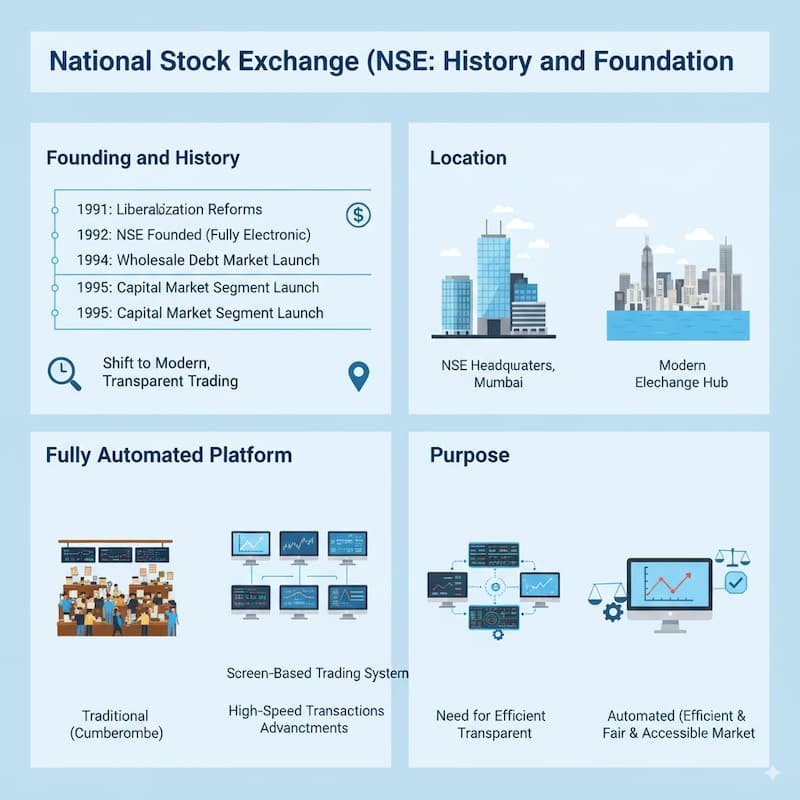
- Founded: The NSE was established in 1992 as a fully electronic exchange, with the goal of providing a modern and transparent trading platform. It was developed in response to the need for a more efficient and less cumbersome way to trade in India’s financial markets.
- Location: Like BSE, NSE is located in Mumbai, but it was designed to be a fully automated exchange from the outset.
Key Features
- Nifty 50: The NSE introduced the Nifty 50, an index representing the top 50 companies listed on the exchange. It is widely followed by investors as a benchmark for the Indian stock market.
- Electronic Trading: The NSE introduced a fully electronic order book system, which eliminated the need for physical trading floors and allowed faster and more transparent trading.
- Market Capitalization: NSE has grown to become the largest exchange in India by trading volume and market capitalization, with a market capitalization of over $2 trillion as well.
📊 Key Differences Between NSE and BSE
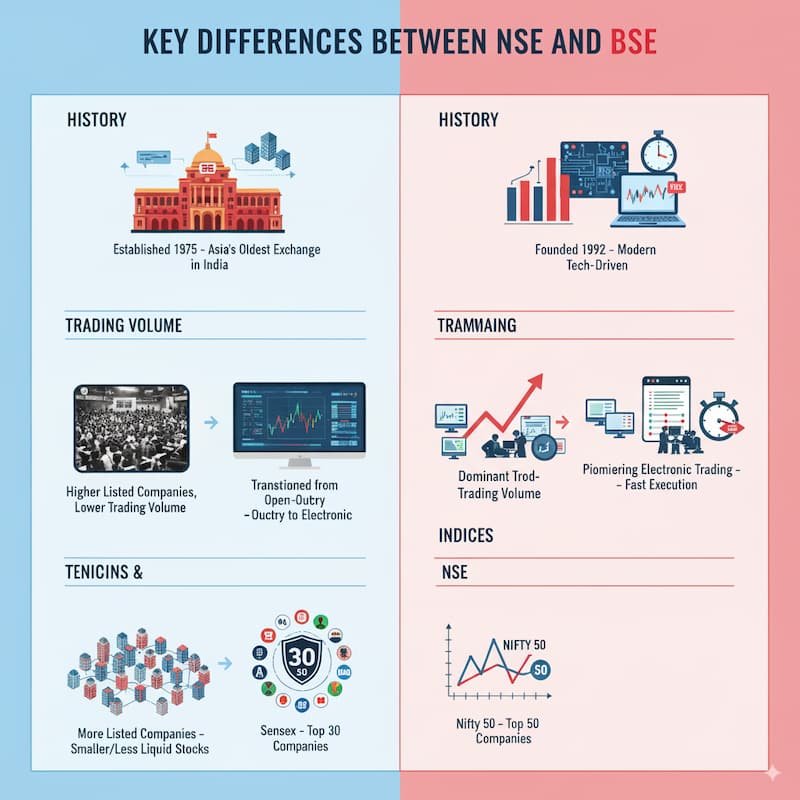
While both the NSE and BSE serve the same purpose of providing a platform for stock trading, they have several key differences that investors should be aware of:
1. History
- BSE: As the oldest exchange in India, BSE has a long history and has been the pioneer in Indian stock trading. It has a more established presence in the market.
- NSE: Founded much later, the NSE was built with modern technology in mind. It brought a wave of innovation to Indian markets, focusing heavily on electronic trading and operational efficiency.
2. Trading Volume
- BSE: While BSE has more listed companies, its daily trading volume is lower than that of the NSE. The BSE’s trading volume primarily comes from smaller companies, whereas larger companies tend to be more active on the NSE.
- NSE: NSE is the dominant exchange in India in terms of trading volume, particularly in equity derivatives. It is the go-to exchange for active traders and institutions due to its high liquidity and more sophisticated technology.
3. Technology and Innovation
- BSE: BSE has transitioned from a traditional open-outcry system to an electronic trading platform, but the NSE was the true innovator in terms of technology.
- NSE: The NSE pioneered electronic trading in India. It introduced a computerized order-book system that significantly reduced trade times and increased transparency.
4. Indices
- BSE: The Sensex is one of the most well-known indices in India and represents 30 major companies on the BSE.
- NSE: The Nifty 50 is the flagship index of the NSE, tracking 50 major companies and often used as a benchmark for the overall market performance.
5. Listing and Market Capitalization
- BSE: While BSE has more listed companies (over 5,000), many of these are smaller or less liquid stocks compared to those listed on the NSE.
- NSE: Although the number of listed companies on the NSE is smaller than that of BSE, the market capitalization and liquidity are generally higher.
🧾 Regulatory Framework
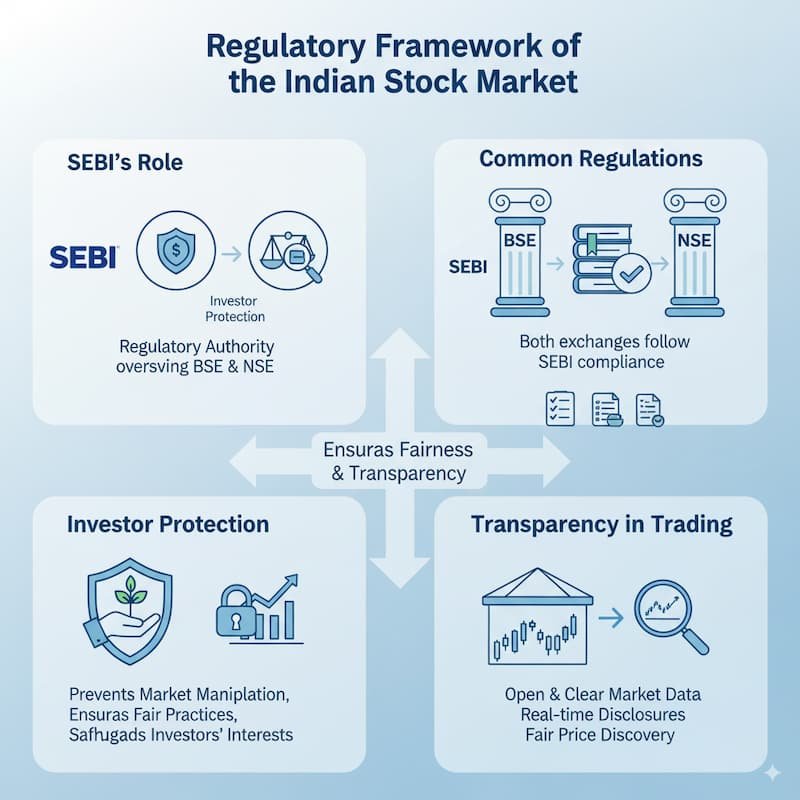
Both exchanges are regulated by SEBI (Securities and Exchange Board of India), which ensures that the stock market operates transparently and fairly. However, the rules and compliance measures followed by the two exchanges are similar, as SEBI imposes common regulations for both. The regulatory measures ensure investor protection, prevent market manipulation, and ensure that trading activities are conducted with transparency.
❓ Frequently Asked Questions (FAQ)
Q1: What is the primary difference between the BSE and NSE?
A: The BSE is the oldest stock exchange in India, founded in 1875, while the NSE was established in 1992 with a focus on electronic trading. NSE is known for higher trading volume and liquidity, particularly in derivatives, whereas BSE has more listed companies.
Q2: What are the main indices of BSE and NSE?
A: The Sensex is the benchmark index of the BSE, tracking 30 large companies, while the Nifty 50 is the index of the NSE, representing the top 50 companies listed on the exchange.
Q3: Which exchange has more listed companies?
A: BSE has more listed companies (over 5,000) compared to NSE, but the companies listed on NSE are typically larger, with greater liquidity.
Q4: Which stock exchange has higher trading volume?
A: NSE generally has a higher trading volume compared to BSE, especially in equity derivatives and futures.
Q5: How do BSE and NSE differ in terms of technology?
A: The NSE was the first to introduce electronic trading, bringing modern technology to India’s markets. BSE also transitioned to electronic trading but started with an open-outcry system.
Q6: Which exchange is better for long-term investors?
A: Both BSE and NSE are suitable for long-term investors, but the Sensex on BSE might be more appropriate for conservative investors, while the Nifty 50 on NSE provides a broader representation of the market.
Q7: Can I trade on both BSE and NSE?
A: Yes, investors can trade on both exchanges. Many brokers provide access to both BSE and NSE platforms, allowing you to choose based on liquidity and stock availability.
Q8: Which exchange is more popular for derivatives trading?
A: NSE is the leader in derivatives trading in India, with more liquidity and a higher volume of contracts traded in equity derivatives.
Q9: How do the market capitalizations of BSE and NSE compare?
A: Both exchanges have a similar market capitalization, but NSE is known for higher trading volumes and is often more liquid, especially in large-cap stocks.
Q10: Which exchange should I use to trade actively?
A: For active traders and institutional investors, NSE is the preferred exchange due to its high liquidity, advanced technology, and better trading volume in derivatives.
🔚 Conclusion
Both the Bombay Stock Exchange (BSE) and National Stock Exchange (NSE) are integral parts of India’s financial ecosystem. While they share similar functions, they differ in terms of history, trading volume, technology, and market focus. Investors can choose between the two based on their investment goals, with the NSE being more popular for active traders and the BSE having a longer legacy. Understanding the nuances of both exchanges can help investors make informed decisions and leverage the strengths of each platform.