
Understanding how the Indian stock market operates is crucial for anyone looking to invest or gain insights into the country’s financial landscape. This guide delves into the mechanisms, participants, and processes that drive the Indian stock market.
📘 Overview of the Indian Stock Market
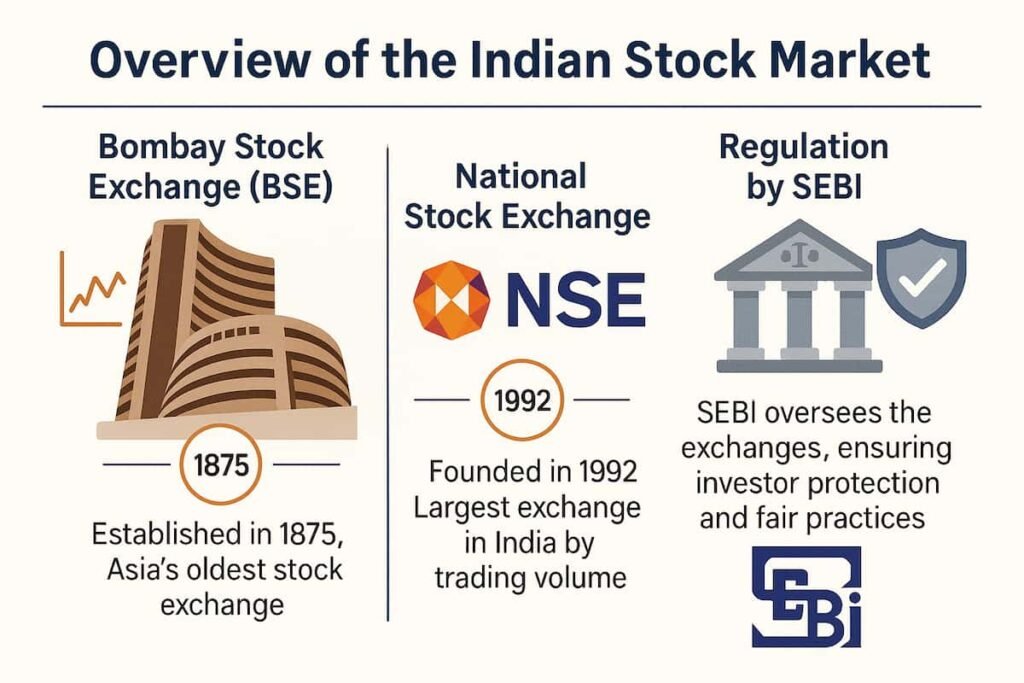
The Indian stock market is a platform where investors buy and sell shares of publicly listed companies. It plays a vital role in the economy by facilitating capital formation for businesses and providing investment opportunities for individuals. The primary stock exchanges in India are:
- Bombay Stock Exchange (BSE): Established in 1875, it’s Asia’s oldest stock exchange.
- National Stock Exchange (NSE): Founded in 1992, it’s the largest in India by trading volume.
These exchanges are regulated by the Securities and Exchange Board of India (SEBI), which ensures fair practices and investor protection.
🧭 Key Components of the Stock Market
1. Stock Exchanges
Stock exchanges are venues where securities are bought and sold. They provide a transparent and regulated environment for trading. In India, BSE and NSE are the primary exchanges, offering electronic trading platforms that ensure efficient and secure transactions.
2. Participants
Several entities participate in the stock market:
- Investors: Individuals or institutions that buy and sell securities.
- Brokers: Intermediaries who facilitate trading on behalf of investors.
- Market Makers: Entities that provide liquidity by buying and selling securities.
- Regulators: Bodies like SEBI that oversee the market’s functioning.
3. Securities
The primary securities traded in the Indian stock market include:
- Equities (Stocks): Shares representing ownership in a company.
- Bonds: Debt instruments issued by corporations or governments.
- Derivatives: Financial contracts whose value is derived from underlying assets.
- Exchange-Traded Funds (ETFs): Investment funds traded on stock exchanges.
🔄 How Trading Works
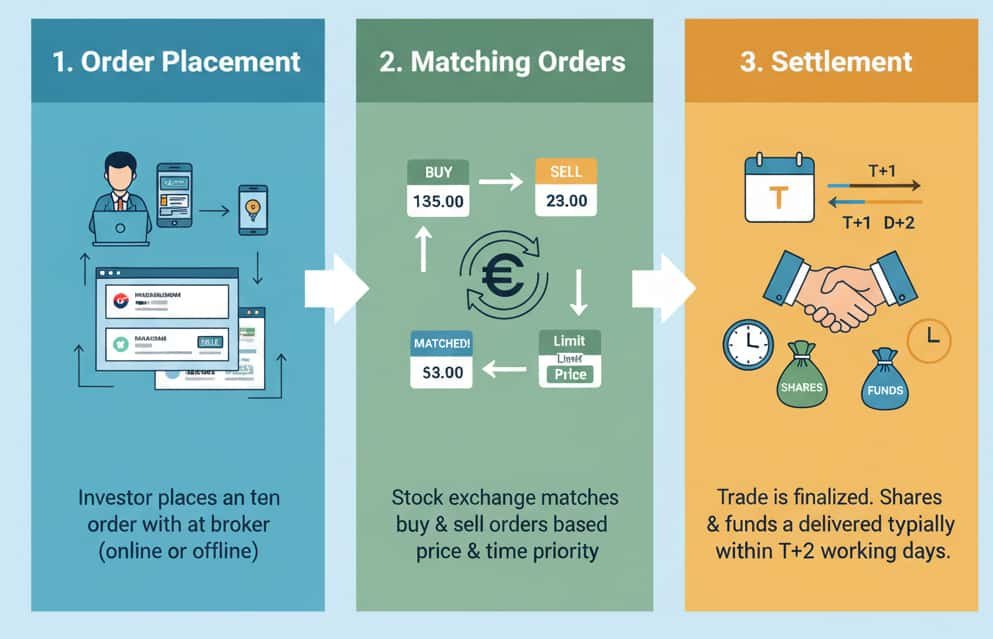
Order Placement
Investors place buy or sell orders through brokers. These orders are then routed to the stock exchange.
Matching Orders
The stock exchange matches buy and sell orders based on price and time priority. Once a match is found, a trade is executed.
Settlement
After a trade is executed, the settlement process begins. In India, the standard settlement cycle is T+2, meaning the transaction is settled two working days after the trade date.
📊 Market Indices
Market indices represent the performance of a group of stocks. They serve as benchmarks for the market’s overall performance. Notable indices in India include:
- Sensex: Comprises 30 major companies listed on the BSE.
- Nifty 50: Represents 50 major companies listed on the NSE.
These indices help investors gauge market trends and make informed investment decisions.
🧾 Regulatory Framework
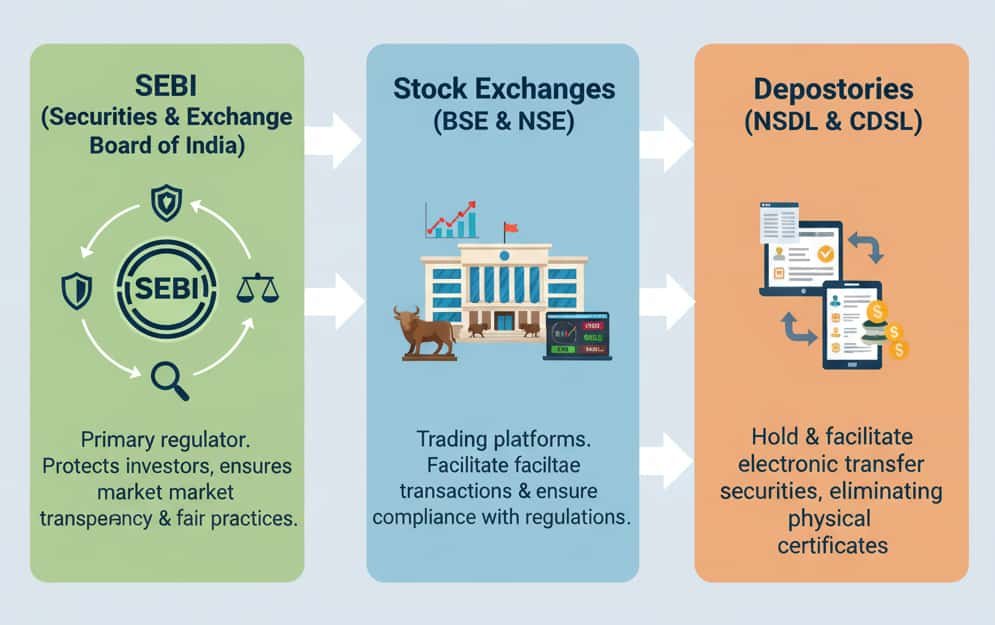
The Indian stock market operates under a robust regulatory framework:
- SEBI: Regulates the securities market to protect investors and ensure fair practices.
- Stock Exchanges: Provide platforms for trading and ensure compliance with regulations.
- Depositories: Facilitate the electronic holding and transfer of securities.
❓ Frequently Asked Questions (FAQ)
Q1: What is the Indian stock market?
A: The Indian stock market is a platform for buying and selling shares of publicly listed companies in India. The two primary exchanges are BSE and NSE.
Q2: How can I start investing in the stock market?
A: To start investing, you need to open a Demat Account and a Trading Account with a SEBI-registered broker. These accounts allow you to hold and trade stocks electronically.
Q3: What are the risks of investing in the stock market?
A: Investing in the stock market carries risks such as market volatility, economic downturns, and individual company performance. It’s important to conduct thorough research and diversify your portfolio.
Q4: How do stock prices change in the market?
A: Stock prices fluctuate based on supply and demand, influenced by factors like a company’s performance, overall market sentiment, and economic conditions.
Q5: What is an IPO (Initial Public Offering)?
A: An IPO is when a company offers its shares to the public for the first time to raise capital. Investors can purchase these shares before they are listed on the stock exchange.
Q6: What is the difference between BSE and NSE?
A: BSE is the oldest stock exchange in India, founded in 1875, while NSE was established in 1992 and is the largest by trading volume. Both exchanges serve similar functions but operate independently.
Q7: What is the role of SEBI in the Indian stock market?
A: The Securities and Exchange Board of India (SEBI) regulates the stock market to ensure transparency, protect investors, and promote the orderly functioning of the market.
Q8: What are stock indices like Sensex and Nifty?
A: Sensex and Nifty are stock market indices that track the performance of a group of major companies. Sensex represents 30 companies, while Nifty includes 50. They help investors gauge market trends.
Q9: How are stock market gains taxed in India?
A: Short-term capital gains (STCG) are taxed at 15% for equity investments held for less than a year, while long-term capital gains (LTCG) exceeding ₹1 lakh are taxed at 10% for equity.
Q10: How can I choose the right stocks to invest in?
A: Research is key when selecting stocks. Look at factors such as the company’s financial health, growth potential, competitive position in the market, and overall industry trends. Diversification also helps spread risk.
💡 Conclusion
The Indian stock market is a dynamic and integral part of the country’s economy. Understanding its structure and functioning is essential for investors to navigate the complexities and make informed decisions. Whether you’re a seasoned investor or a beginner, staying informed about the market’s workings can enhance your investment strategies.