

The Indian stock market has evolved from informal trading under banyan trees to becoming one of the largest and most dynamic financial markets in the world. This journey is marked by significant milestones that have shaped its current structure and global standing.
📜 Early Beginnings (1830s–1875)
- 1830s: Informal trading of corporate shares, including those of banks and cotton presses, began in Mumbai under a banyan tree near the Town Hall.
- 1850s: A group of brokers formalized these gatherings, laying the foundation for organized stock trading.
- 1875: The Native Share & Stock Brokers Association was established in Mumbai, which later became the Bombay Stock Exchange (BSE), Asia’s oldest stock exchange.

🏛️ Establishment of Key Institutions
- 1956: The Securities Contracts (Regulation) Act was enacted, providing a legal framework for the regulation of stock exchanges in India.
- 1964: The Unit Trust of India (UTI) launched India’s first mutual fund scheme, US-64, marking a significant development in the country’s investment landscape.
- 1986: The BSE introduced the S&P BSE Sensex, a 30-share index, serving as a benchmark for the Indian stock market.
- 1992: The National Stock Exchange (NSE) was established, introducing electronic trading to India and enhancing market transparency.
📈 Economic Liberalization and Technological Advancements
- 1991: India embarked on economic liberalization, opening its markets to foreign investments and leading to significant growth in the stock market.
- 1992: The Harshad Mehta scam exposed significant loopholes in the financial system, prompting major reforms in market regulations.
- 1994: The NSE launched the Nifty 50 index, representing 50 major companies listed on the exchange.
- 2000s: The advent of online trading platforms democratized access to the stock market, allowing retail investors to participate more actively.
📉 Market Crashes and Regulatory Reforms
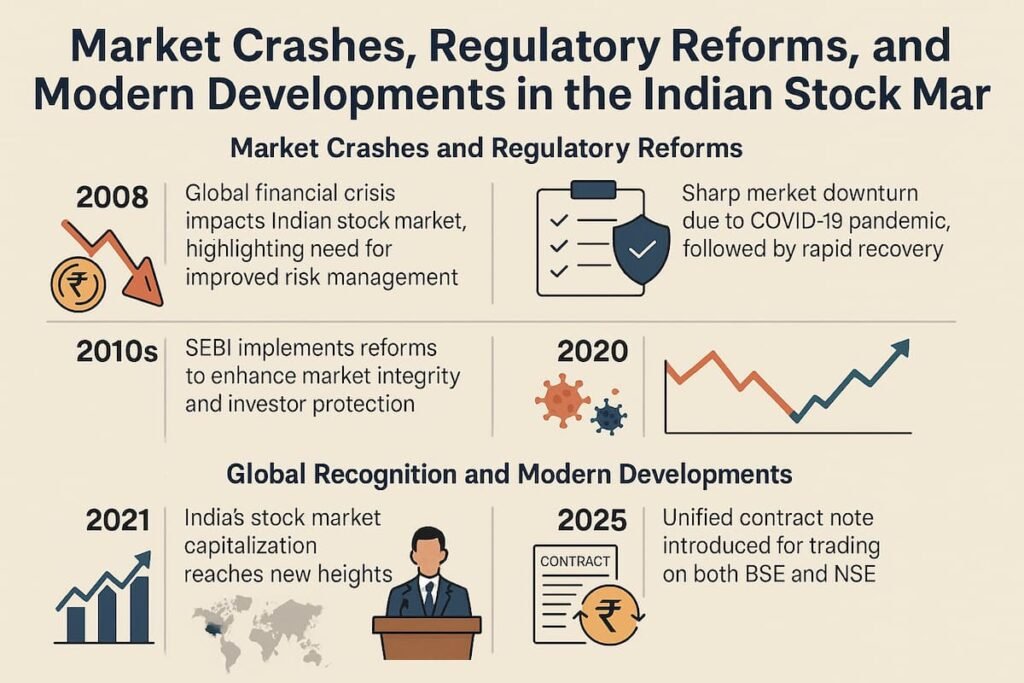
- 2008: The global financial crisis led to significant declines in the Indian stock market, highlighting the need for robust risk management systems.
- 2010s: The Securities and Exchange Board of India (SEBI) implemented various reforms to enhance market integrity and investor protection.
- 2020: The COVID-19 pandemic caused a sharp market downturn, followed by a rapid recovery, demonstrating the resilience of the Indian stock market.
🌐 Global Recognition and Modern Developments
- 2021: India’s stock market capitalization reached new heights, reflecting the country’s growing economic stature.
- 2025: The NSE appointed Srinivas Injeti as its chairperson, signaling a move toward its long-awaited public listing.
- 2025: The introduction of a unified contract note for trading on both BSE and NSE streamlined market practices and enhanced transparency.
❓ Frequently Asked Questions (FAQ)
Q1: When did the Indian stock market begin?
A: The origins of the Indian stock market date back to the 1830s when informal trading occurred in Mumbai.
Q2: What is the Sensex?
A: The Sensex is a 30-share index introduced by the BSE in 1986, serving as a benchmark for the Indian stock market.
Q3: What led to the establishment of the NSE?
A: The NSE was established in 1992 to introduce electronic trading and enhance market transparency.
Q4: How did the 1992 scam impact the market?
A: The scam exposed significant loopholes, prompting major reforms in market regulations.
Q5: What role did SEBI play in market reforms?
A: SEBI implemented various reforms to enhance market integrity and investor protection.
Q6: How did the 2008 financial crisis affect India?
A: The crisis led to significant declines in the stock market, highlighting the need for robust risk management systems.
Q7: What is the Nifty 50 index?
A: The Nifty 50 is a benchmark index representing 50 major companies listed on the NSE, launched in 1994.
Q8: How has technology influenced trading?
A: The advent of online trading platforms democratized access to the stock market, allowing retail investors to participate more actively.
Q9: What is the current status of the NSE?
A: The NSE is the world’s largest derivatives exchange and is moving towards its long-awaited public listing.
Q10: How does the Indian stock market compare globally?
A: India’s stock market capitalization has reached new heights, reflecting the country’s growing economic stature.
🔚 Conclusion
The history of the Indian stock market is a testament to the country’s economic evolution and resilience. From its humble beginnings to becoming a global financial powerhouse, the journey reflects the dynamic interplay of policy reforms, technological advancements, and investor participation. As India continues to integrate with the global economy, the stock market is poised to play an even more pivotal role in shaping the nation’s financial future.