

In India, a Demat account is a necessity for anyone wishing to invest in the stock market. The term “Demat” stands for “Dematerialized,” meaning that it allows investors to hold financial securities, such as stocks, bonds, mutual funds, and exchange-traded funds (ETFs), in an electronic format rather than physical certificates. This shift to electronic storage offers several advantages, including security, efficiency, and ease of access.
Let’s explore what exactly a Demat account is, how it works, and why it is crucial for investors in India.
📘 What Is a Demat Account?
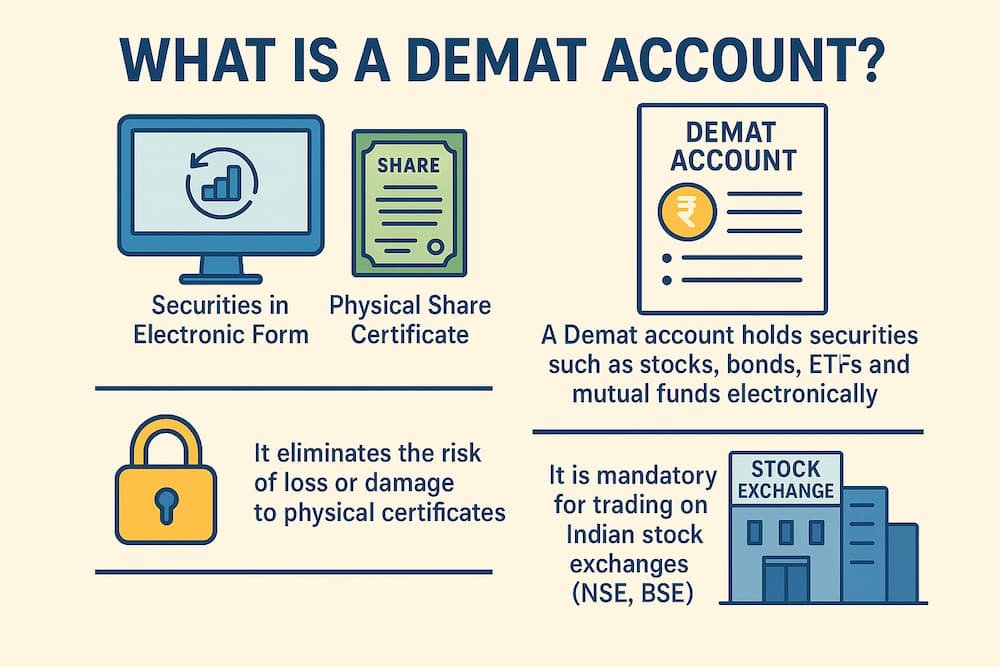
A Demat account (short for dematerialized account) is a type of account used to hold securities in an electronic form. Unlike traditional methods of storing physical share certificates, a Demat account stores these assets electronically, eliminating the risk of losing or damaging the certificates. In India, it is mandatory to have a Demat account to participate in buying or selling securities through the stock market.
🔑 Why Do You Need a Demat Account?
A Demat account is required for buying, holding, and selling shares and other financial instruments like bonds, ETFs, and mutual funds. Without a Demat account, you cannot trade on the Indian stock exchanges, such as the NSE (National Stock Exchange) or BSE (Bombay Stock Exchange). Here’s why having a Demat account is essential for investors:
- Required for Trading: Without a Demat account, you cannot engage in buying or selling securities on the stock exchanges.
- Electronic Transactions: It allows investors to transact in securities electronically, making the process faster and more efficient.
- Mandatory for Investment in Stocks and Bonds: If you are investing in stocks or bonds, a Demat account is required for holding your securities.
✅ Benefits of a Demat Account
- Secure Storage:
- The main advantage of a Demat account is the safe storage of your securities. Since there is no physical form, the risks associated with paper-based securities (such as loss, theft, or damage) are eliminated.
- Convenient Access:
- With a Demat account, you can view and manage your holdings online through a secure portal. This means you have easy and real-time access to your portfolio, making it easier to keep track of your investments.
- Easy Transfer of Securities:
- A Demat account enables easy transfer of securities between accounts. For example, when you sell stocks, they are debited from your Demat account, and when you buy stocks, they are credited directly to it.
- Automatic Updates for Corporate Actions:
- Corporate actions such as dividends, stock splits, and bonuses are automatically updated in your Demat account, so you do not need to manually track these changes.
- Loan Collateral:
- The securities in your Demat account can be used as collateral for loans, allowing you to access financing without selling your investments.
- Cost-Effective:
- A Demat account reduces the need for paperwork and eliminates stamp duties associated with physical share certificates. This helps cut costs related to paper-based transactions.
🛠️ How Does a Demat Account Work?
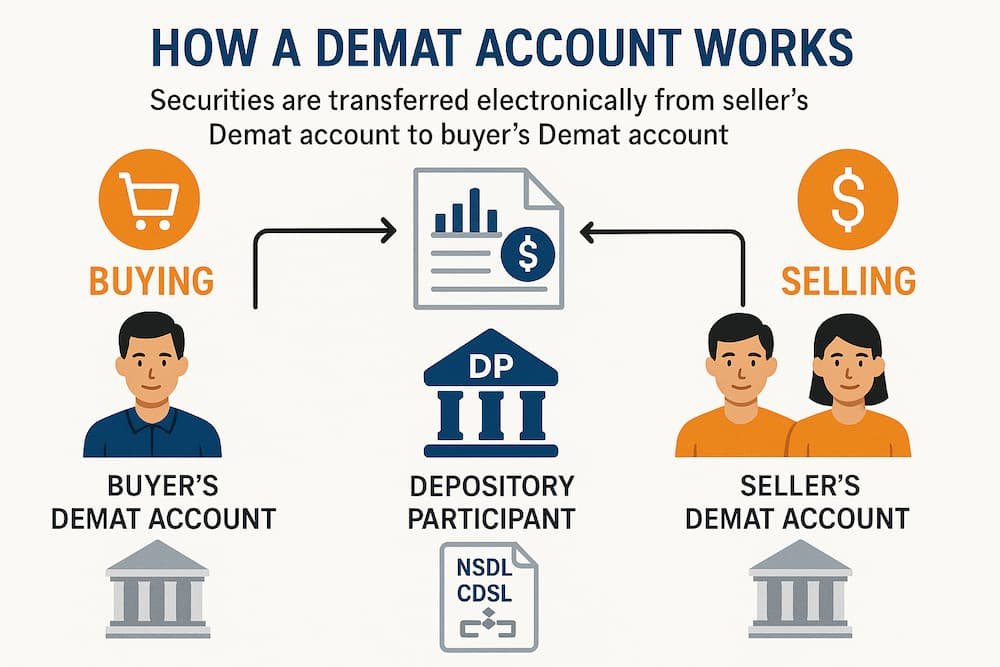
When you buy or sell securities, they are directly credited or debited to/from your Demat account. The process works as follows:
- Buying Securities: When you buy securities, they are transferred from the seller’s Demat account to your Demat account.
- Selling Securities: When you sell securities, they are transferred from your Demat account to the buyer’s Demat account.
These transactions are done electronically through a Depository Participant (DP), which is a registered intermediary between the investor and the depository (NSDL or CDSL). The DP facilitates the transfer of securities, ensuring that the buying and selling processes are seamless.
🧾 Types of Demat Accounts
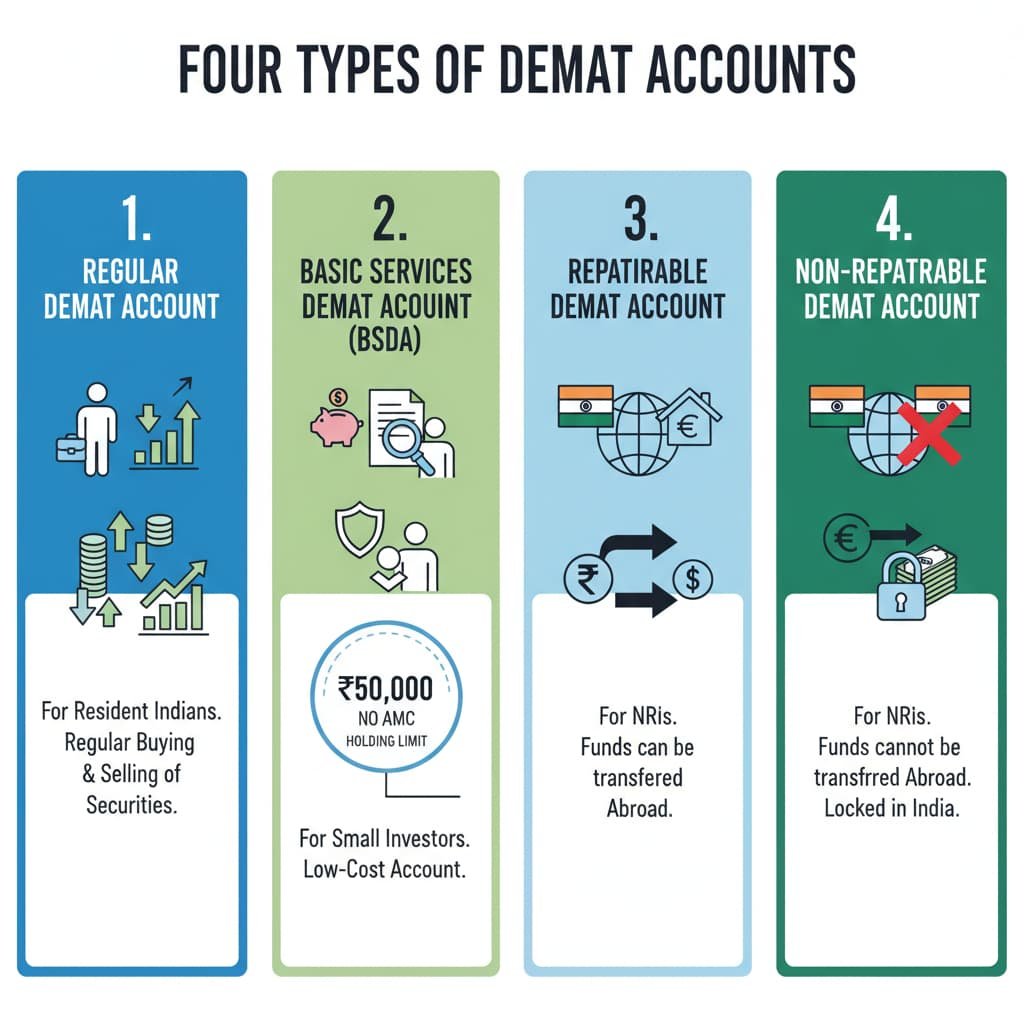
- Regular Demat Account:
- This type of Demat account is for Indian residents who engage in the buying and selling of stocks or other financial securities on a regular basis. It is the most commonly used account type.
- Basic Services Demat Account (BSDA):
- This is a low-cost option for small investors. If the value of securities in your account does not exceed ₹50,000, there are no annual maintenance charges.
- Repatriable Demat Account:
- This type is for Non-Resident Indians (NRIs) who wish to transfer funds outside India. It allows NRIs to repatriate the money to their country of residence.
- Non-Repatriable Demat Account:
- This is another option for NRIs, but the funds in a non-repatriable Demat account cannot be transferred abroad. The funds must remain in India.
📝 Documents Required to Open a Demat Account
Opening a Demat account involves submitting certain documents for verification. The following documents are typically required:
- PAN Card: A Permanent Account Number (PAN) is mandatory for all financial transactions.
- Aadhaar Card: Used for identity verification and address proof.
- Bank Account Details: A cancelled cheque or a bank statement is needed to link the Demat account with your bank account.
- Passport-sized Photographs: Usually, two recent passport-sized photographs are required.
- Income Proof: Required for margin trading and derivatives trading.
After submitting the required documents, the Depository Participant (DP) will carry out a Know Your Customer (KYC) process for verification, and your Demat account will be activated.
🧭 Steps to Open a Demat Account
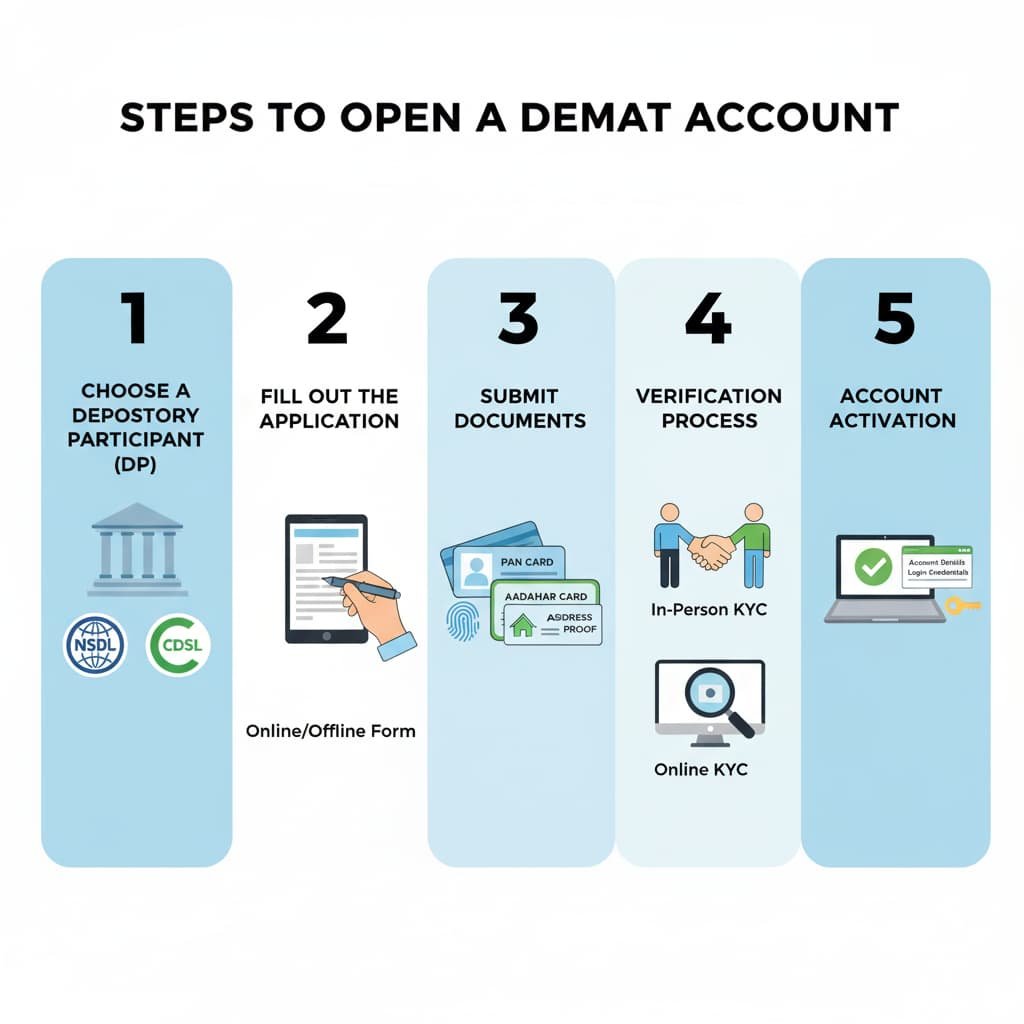
- Choose a Depository Participant (DP):
- You can open a Demat account through a bank or a brokerage firm registered with either NSDL or CDSL.
- Fill Out the Application:
- Complete the Demat account application form provided by the DP, either online or offline.
- Submit the Documents:
- Submit the required KYC documents for verification. These documents include your PAN card, Aadhaar card, address proof, and a passport-sized photograph.
- Verification Process:
- Once the documents are submitted, the DP will carry out the KYC verification. This may involve in-person verification (IPV) or an online verification process.
- Account Activation:
- After successful verification, the DP will activate your Demat account, and you will receive your account details along with login credentials for online access.
📊 Demat Account vs. Trading Account
| Feature | Demat Account | Trading Account |
|---|---|---|
| Purpose | Holds securities in electronic form | Facilitates buying and selling of securities |
| Mandatory for | Holding shares and securities | Executing buy and sell orders |
| Linked With | Bank account and Trading account | Demat account and Bank account |
| Transactions | Credit and debit of securities | Execution of buy/sell orders |
| Access | Online through DP’s platform | Online through broker’s trading platform |
A Demat account is essential for holding securities, while a trading account is required for executing buy and sell orders on the market.
💡 Conclusion
A Demat account is an essential tool for any investor looking to trade or invest in the Indian stock market. It offers a secure, efficient, and cost-effective way to hold and manage securities. The benefits of a Demat account, such as easy access, real-time updates, and electronic transactions, make it an indispensable component of the modern investment process.
For anyone looking to get started in the stock market, opening a Demat account is the first step. Whether you are an experienced investor or a beginner, having a Demat account is mandatory to trade and invest in the financial markets in India.