
India’s financial markets are often represented by two key indices—Nifty and Sensex. These indices act as barometers of the stock market and the broader economy, reflecting investor sentiment, economic trends, and market movements. For anyone interested in the Indian stock market, understanding the Nifty and Sensex indices is essential. This blog delves deeper into what these indices represent, how they differ, and why they are important for investors.
📊 What Are Stock Market Indices?
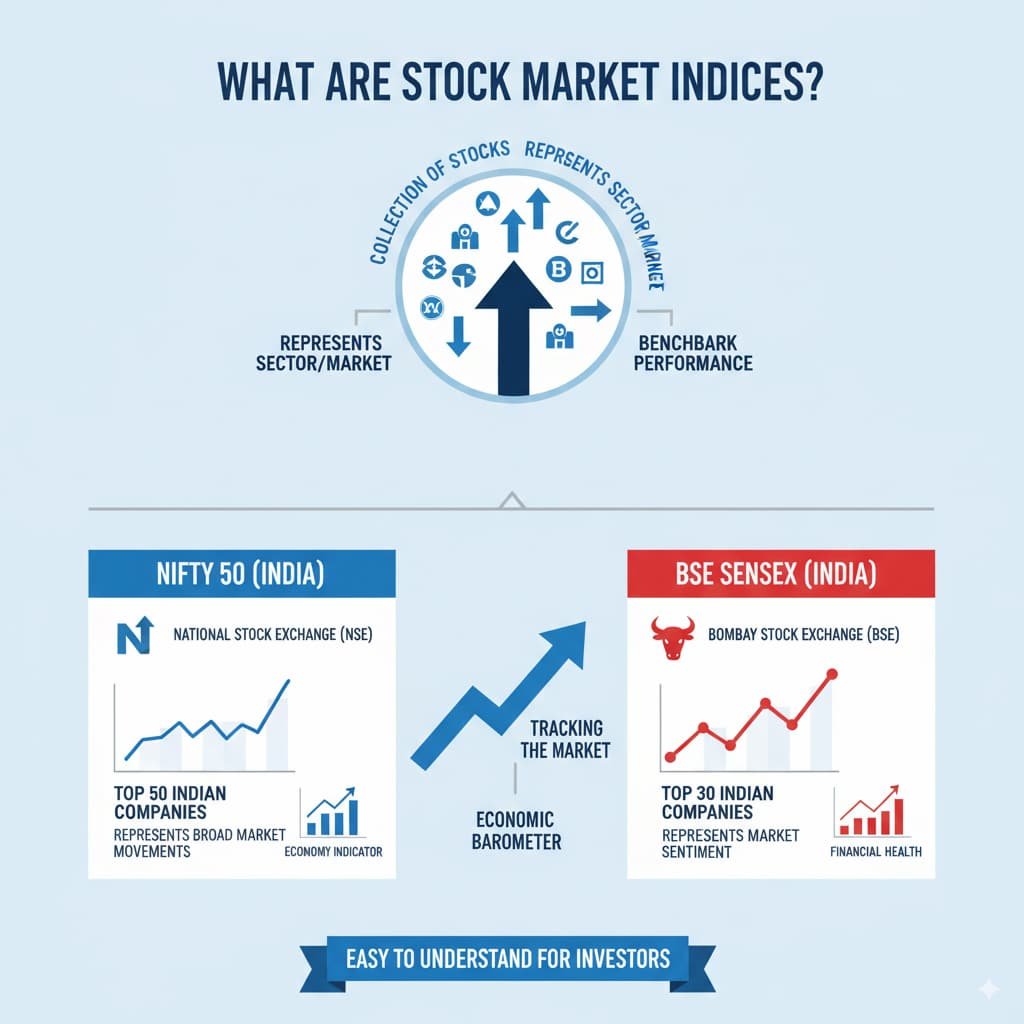
Before diving into Nifty and Sensex, it’s essential to understand the concept of a stock market index. A stock market index is a compilation of a specific set of stocks designed to represent the performance of a particular sector or the entire market. It serves as a reflection of market trends, providing investors with a way to track stock performance, compare their portfolios, and gauge the health of the economy.
In India, the Nifty 50 and the BSE Sensex are two of the most influential indices.
🔹 Nifty 50: The National Benchmark
The Nifty 50, also known as Nifty, is one of the two primary indices that investors follow in India. Representing the top 50 companies listed on the National Stock Exchange (NSE), it is a market-capitalization-weighted index that tracks the performance of large, liquid, and financially stable companies.
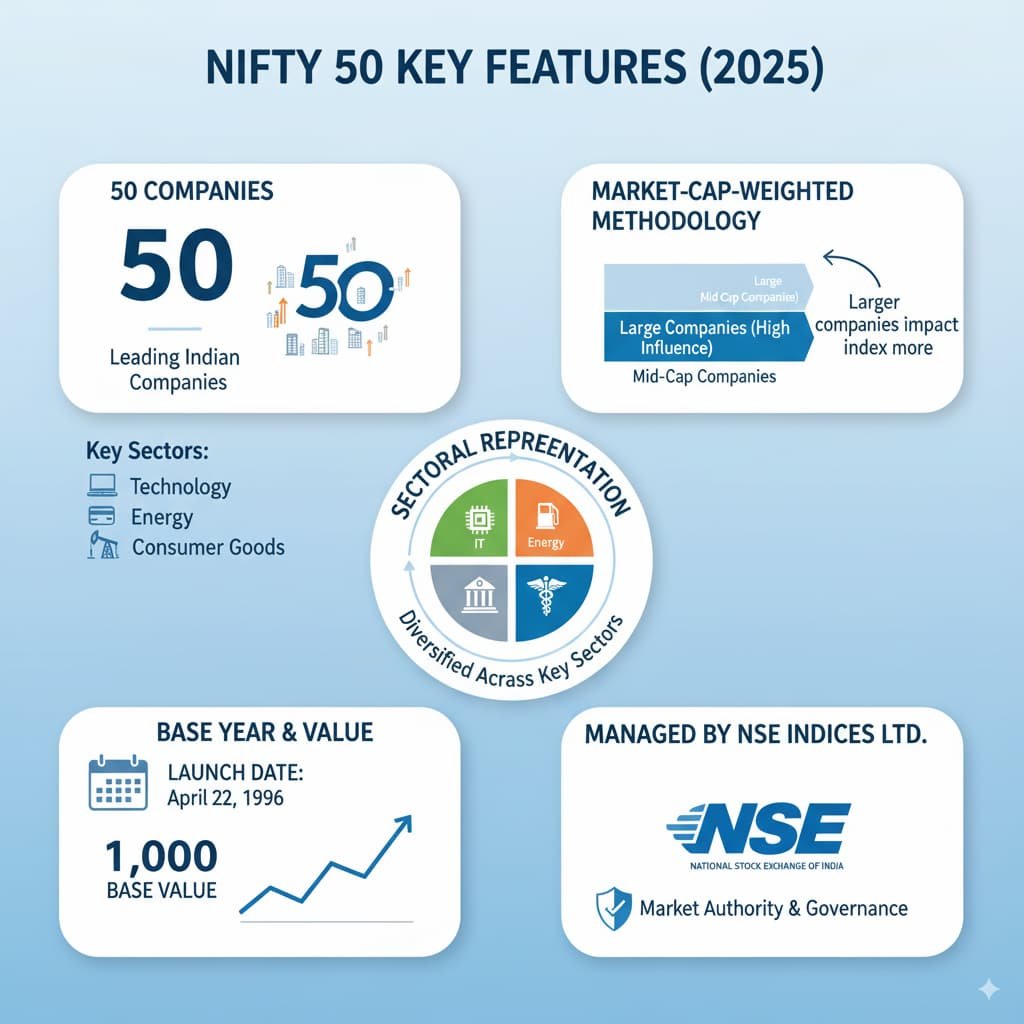
Key Features of Nifty:
- Number of Stocks: 50 companies, primarily from sectors like technology, finance, energy, and consumer goods.
- Weighting Method: Market-capitalization-weighted, meaning larger companies with a higher market value have more influence on the index.
- Sectoral Representation: The Nifty index spans 13 sectors, offering a diverse look at the Indian economy. Key sectors include Information Technology (IT), energy, financials, and healthcare.
- Base Year and Value: Launched on April 22, 1996, with a base value of 1,000.
- Managed By: NSE Indices Ltd, a subsidiary of the National Stock Exchange.
Nifty 50 is a widely-used benchmark in the Indian stock market. It represents a diversified group of companies and gives a broader view of the economy, making it an essential tool for investors looking to track market trends.
🔹 BSE Sensex: The Sensitive Index
The BSE Sensex is one of India’s oldest stock indices, introduced in 1986. It consists of 30 companies listed on the Bombay Stock Exchange (BSE). These companies are chosen based on their significance in the Indian economy, liquidity, and their performance in the market. The Sensex is considered a barometer of India’s financial market.
Key Features of Sensex:
- Number of Stocks: 30 top-performing companies.
- Weighting Method: Similar to Nifty, the Sensex uses free-float market capitalization, giving more weight to larger companies.
- Sectoral Representation: The Sensex also spans a wide range of sectors like banking, IT, consumer goods, and energy, but it has a more concentrated representation compared to Nifty.
- Base Year and Value: Introduced in 1986 with a base value of 100.
- Managed By: Asia Index Private Limited, a joint venture between BSE and S&P Dow Jones Indices.
The Sensex is more concentrated than the Nifty, with fewer stocks but often considered a closer indicator of the Indian stock market’s sentiment.
🔍 Nifty vs. Sensex: Key Differences
Here’s a detailed comparison of Nifty and Sensex based on various factors:
| Feature | Nifty 50 | BSE Sensex |
|---|---|---|
| Number of Stocks | 50 | 30 |
| Exchange | National Stock Exchange (NSE) | Bombay Stock Exchange (BSE) |
| Weighting Method | Market capitalization-weighted | Free-float market capitalization-weighted |
| Sector Coverage | Broader, spanning 13 sectors | More concentrated across key sectors |
| Market Representation | Represents a broad market spectrum | Represents a concentrated market segment |
| Base Year | 1995 | 1978–79 |
| Base Value | 1,000 | 100 |
| Performance Metric | More dynamic, diverse | Sensitive to market sentiment and trends |
| Management | Managed by NSE Indices Limited | Managed by Asia Index Private Limited |
While both indices track India’s economic performance, Nifty offers a broader and more diversified representation, whereas Sensex provides a more concentrated view of the top-performing companies.
📈 Importance of Nifty and Sensex
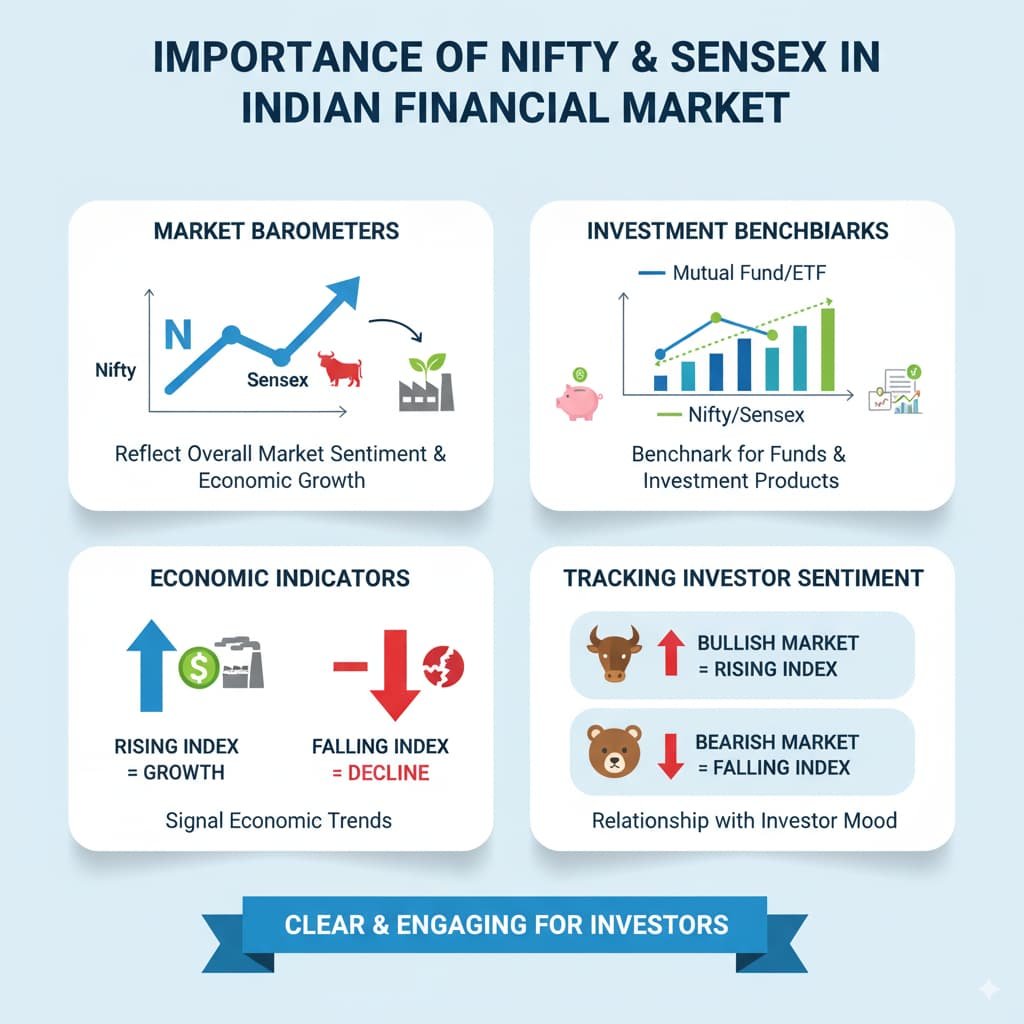
Both Nifty and Sensex are crucial to understanding India’s financial market. Here’s why they are important:
- Market Barometers: Nifty and Sensex reflect the overall market sentiment. Investors look to these indices to gauge how well the market is performing, and a rising index indicates economic growth.
- Investment Benchmarks: These indices are used as benchmarks for mutual funds, ETFs, and other investment products. If a mutual fund outperforms the Nifty or Sensex, it indicates superior management.
- Economic Indicators: A rising or falling index often signals underlying economic trends. A decline in the index might indicate economic slowdowns or bearish market conditions.
- Tracking Investor Sentiment: Both indices are closely monitored to track investor sentiment. A rising Sensex or Nifty indicates optimism, while a fall may signal pessimism or uncertainty.
❓ Frequently Asked Questions (FAQ)
- What are the key differences between Nifty and Sensex?
- Nifty tracks 50 companies, while Sensex tracks 30. Nifty is considered more diversified, and Sensex is a more concentrated measure of the top-performing companies.
- Which index is better for investment tracking, Nifty or Sensex?
- It depends on your investment strategy. Nifty offers a broader market view, while Sensex is ideal for tracking the performance of India’s largest companies. Both have their own advantages based on the sectors and the type of exposure you’re seeking.
- How are Nifty and Sensex calculated?
- Both indices are market capitalization-weighted. Nifty uses free-float market capitalization, while Sensex uses a free-float method for its calculation as well, but with different weights assigned to the companies based on their size and market value.
- Can I invest directly in Nifty or Sensex?
- You cannot invest directly in an index. However, you can invest in index funds or exchange-traded funds (ETFs) that track the performance of Nifty or Sensex, allowing you to gain exposure to the broader market.
- Why do Nifty and Sensex matter to the Indian economy?
- Both indices act as barometers for investor sentiment and the economic health of India. Policymakers, investors, and analysts rely on them to gauge market trends and economic performance.
- Are there any risks associated with investing in indices like Nifty and Sensex?
- While investing in indices provides diversification, there are risks such as market volatility, economic downturns, and sector-specific challenges. It’s important to balance such investments with other asset classes.
💡 Conclusion
Nifty and Sensex are pivotal to understanding the performance of India’s stock market. Whether you’re an investor tracking market trends or simply curious about India’s economic health, these indices offer valuable insights. The Nifty 50 provides a broader market view, while the BSE Sensex offers a more concentrated look at the top companies in India. Both indices have their importance, and understanding their differences is essential for making informed investment decisions.
By staying informed about these indices, investors can make better portfolio decisions, track market trends, and evaluate the overall sentiment of the Indian stock market.